50th Anniversary Celebration: A Cross Country Dynasty
12/22/2025 9:08:00 AM | Men's Cross Country/Track & Field, Women's Cross Country/Track & Field
Despite the seemingly endless changes that have come through UMass Lowell Athletics in the 50 years since the merger of Lowell Tech and Lowell State, one thing that has remained consistent has been the excellence of the cross country program. Across eras and divisions, generation after generation of distance runners have succeeded in Lowell thanks to a culture of hard work and tenacity.
From city streets and wooded trails to conference championships and national stages, UMass Lowell cross country has never relied on shortcuts. Instead, the program’s legacy has been shaped by people, student-athletes and coaches alike, who understood that sustained success is earned one mile at a time.
Like in many other sports, Lowell Tech and Lowell State began as opponents on the course before fully unifying. For UMass Lowell Athletics Hall of Famer Bob Hodge ’78, that rivalry ultimately led him back to school and into a new program.
“One of the reasons I wound up coming back was seeing a meet between Lowell Tech and Lowell State,” Hodge said. “I jumped in the race, met some of the guys, and that’s really how it started.”
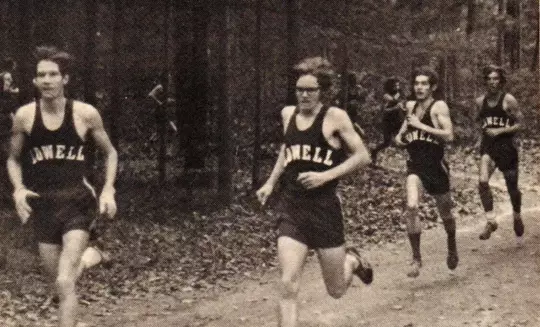
For the newly unified University of Lowell team under the direction of former Lowell Tech head coach and future Hall of Famer George Davis, training conditions were modest and facilities were limited. Distance runners logged miles through Lowell’s neighborhoods and the Dracut State Forest, often regardless of weather.
“It didn’t matter what the conditions were,” Hodge said. “The distance runners just went out.”
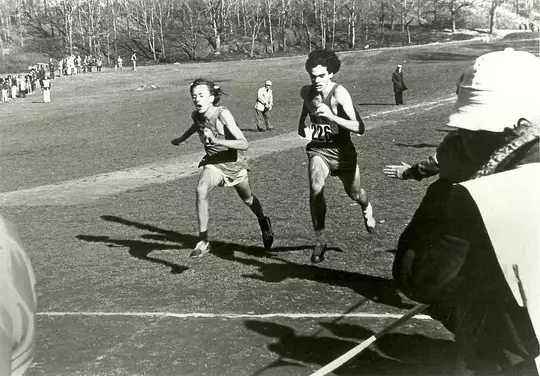
Despite limited resources, the program earned national credibility immediately after the merger as UMass Lowell Hall of Famer Vinnie Fleming became the school’s first ever national champion that fall in 1975.
“I saw him come down the hill and he was in like 10th place, but then he just started passing them all one at a time,” Hodge recalled. “Right at the finish, you could see them both lean and it took them a while to decide who won because they didn’t have the sophisticated timing we have now. When Vinnie won, his picture was everywhere.”
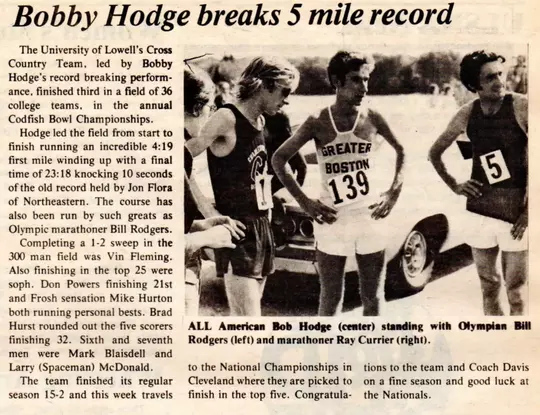
The very next season in 1976, Hodge became the university’s first Division I All-American, competing against traditional national powers.
“I came in second in the Division III National Championship and the top four got to move on to the Division I meet, so George and I went to Denton, Texas. When they wrote ‘Lowell’ next to my name, people were asking where it was,” Hodge reminisced. “That was pretty cool.”
Those moments mattered. They affirmed that UMass Lowell could compete nationally, even without the advantages of larger institutions.
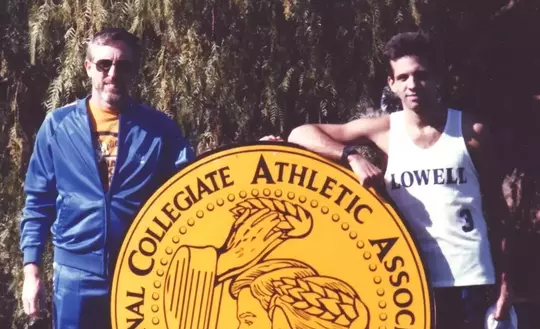
As the program matured, leadership became one of its defining strengths, featuring just two head coaches in more than 50 years, beginning with Davis from 1970-2002.
“Everybody had different personalities, and everybody had different things that motivated them,” explained Hall of Famer John Doherty ’93 regarding the inaugural head coach’s style. “One person needed him to be a little bit more stern, while other people needed him to be a little bit hands off. George always knew what buttons to press on everybody.”
“George was always very gracious to me even as a student-athlete at Keene State,” added current head coach Gary Gardner, who took over for Davis in 2003. “Then when I got into coaching, I talked to him at different meets that we happened to be at and always just touched base.
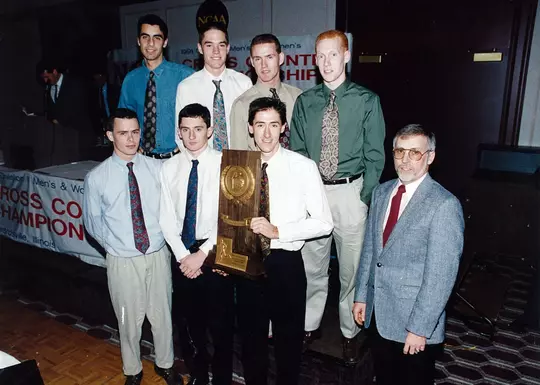
By 1991, the UMass Lowell men’s cross country team had established a strong reputation in Division II, and Doherty and his teammates were not looking to settle.
“Our mission at the beginning of the year was to get to nationals,” commented Doherty. “The rankings came out each week, and each week we kept moving up. After the regionals, we really started thinking that this could be a reality.”
The ULowell team remains the sole Division II New England cross country team - men's or women's - to capture an NCAA title. The team did it by scoring a 48, the second-lowest point total in championship history at the time, and placing three runners among the top four spots and five among the top 20.
“On the national championship day, we couldn’t have gotten a better course on a better day for our team,” Doherty remembered. “Everybody that day had the race of their lives. The pack was stronger than the individual. Nobody was doing it alone.”
More than a decade later, when Gardner took over the program, he inherited a culture already rooted in accountability and expectation.
“There was a high standard here already,” Gardner said. “My job was to protect that and build on it.”
And building on the already incredible history of the program is exactly what Gardner did, carrying on the culture and legacy of Davis and his alums.
“We go after blue-collar kids who want to work hard and buy in and want to be here,” Gardner explained. “If they don’t buy into the school and the program, they’re not going to be successful.”
That philosophy has resonated across both the men’s and women’s cross country programs under Gardner’s tutelage. And while the men’s program was already strongly established before his arrival, the women’s side hadn’t quite had it’s moment of growth just yet.
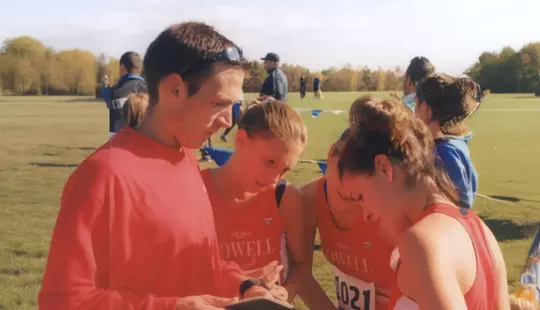
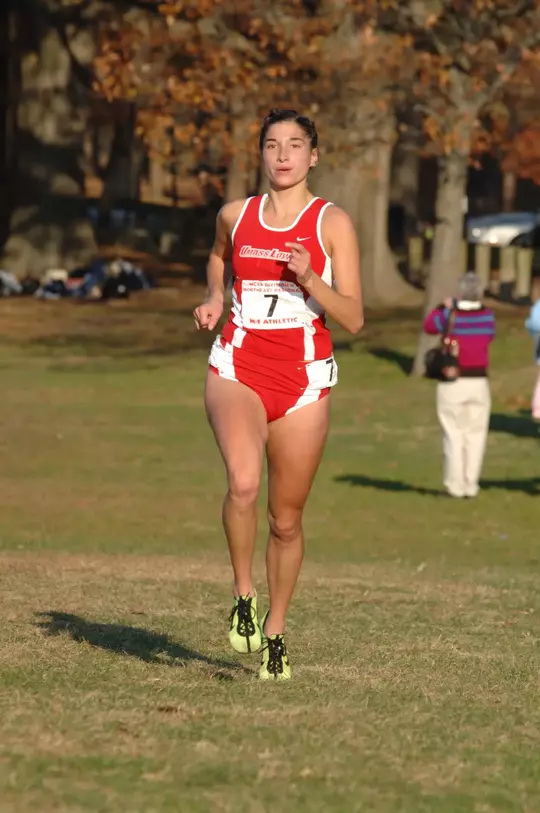
It was really the arrival of Hall of Famer Nicole Plante Hunt ’08 and her classmates that was a turning point for the squad.
“I inherited a women’s cross country team that had four women, so I had to talk one of our hurdlers into running cross country so we could score as a team,” Gardner said with a laugh. “There were 15 teams in the Northeast 10 and we finished 14th that year. Nicole Plante came in that next recruiting class and we went from 14th in the conference to making the NCAA Championship and finishing second in the region.”
Hunt recalled how good it felt for her team to bring success to Lowell, but shared it wouldn’t have been possible without the leadership from Gardner.
“Gary was so welcoming and made this place feel like home. He believed in you, even when you didn’t believe in yourself,” Hunt said of Gardner. “That made a huge difference.”
In 2006, Hunt led the River Hawks to a top-20 finish at the NCAA Division II National Championship, placing second individually.
“I just wanted to set the pace from the start and then with about a mile left, I started picking it up so I could make a gap and lose everyone behind me,” Hunt commented.
A few years later, the move to Division I tested the program’s foundation, but moments of validation quickly followed.
“Our first year in Division I was when we brought in Paul Hogan, Bobby Allen, all those kids, and that year we lost the conference championship by one or two points, but the next year, we won our first America East title by 32 points,” Gardner stated.
For Paul Hogan ’18, what was most special about helping to lead the River Hawks to that first championship was the team.
“Years and months went into training for that race, and it all was presented that day,” Hogan recalled. “Winning the America East Championship and going to nationals - those were unforgettable - but it was the people that made it special. We all pushed each other. The team was greater than the sum of its parts.”
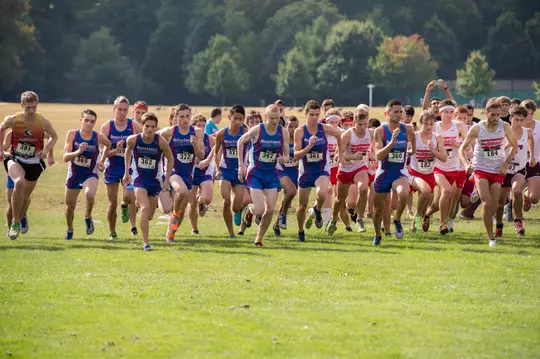
Decades after the merger, with champions at all levels, including the past six America East titles on the men’s side, the program’s alumni remain closely tied to one another and to UMass Lowell.
“Success now is seeing alumni come back,” Gardner said. “Weddings, kids, families: that means more than championships.”
Those bonds persist because of the culture that built them. Doherty described former teammates as lifelong brothers, while Hunt reflected on the sacrifices that made success possible.
“You give things up,” Hunt said. “Social stuff, free time. But it’s worth it because of what you build together.”
Fifty years as one, UMass Lowell cross country continues to reflect the values that built it: hard work, grit and community.
“It reflects Lowell,” Gardner concluded. “It reflects the people who came before.”
As the university looks ahead, the miles continue to add up - not just on the course, but across generations of River Hawks who helped build a program defined not by a moment, but by a lasting legacy.